Learn what a Photo Dump on Instagram is and get tips on adopting this trend as a strategy for your brand
You have probably heard of the Photo Dump, one of the trends that has gained the most attention on Instagram lately. But do you know what it is and how you can use this strategy to benefit your business?
In this article, we explore what a Photo Dump means and the most important things to know about it. Keep reading to learn:
- What is a Photo Dump on Instagram?
- Which tools are used for a Photo Dump?
- Why is this type of post so popular?
- How does a Photo Dump benefit your business?
- How do you make a Photo Dump?
- Photo Dump trends
- Tips for businesses that want to join the trend
- FAQ: common questions about the trend
- Final thoughts
No time to read? Click the player below to listen to the content.
What is a Photo Dump on Instagram?
The term Photo Dump refers to a collection of “random” photos posted in a single Instagram carousel, usually with a relaxed and authentic touch.
Unlike traditional posts, which are often carefully planned and edited, this trend values spontaneity and the reality behind the images.
Its meaning is therefore tied to the search for authenticity on social media. In an environment full of filtered, seemingly flawless images, the Photo Dump offers a breath of reality.
It lets users and brands share genuine moments, building a deeper and more honest connection with their followers.
– Read also: Instagram DM: How to Use It to Engage with Your Audience
Which tools are used for a Photo Dump?
A Photo Dump can be posted both in the feed and in Instagram stories. In the feed, you use the carousel feature to share several photos in a single post.
In stories, you can create a sequence of images that stay available for 24 hours, offering a more immediate (if temporary) view of the moments you share.
Why is this type of post so popular?
Whether in the feed or in stories, the Instagram dump has taken off for several reasons. The main ones are:
- Fatigue with artificial perfection: users are increasingly tired of overly polished, unrealistic content, and the Photo Dump offers a more genuine alternative on the platform;
- Appreciation for authenticity: people increasingly value brands and individuals who show their human, imperfect side;
- Ease and convenience: for brands, it is an efficient way to share multiple pieces of content without a separate post for each photo;
- Connection with younger audiences: finally, younger generations, such as Millennials and Gen Z, value transparency and authenticity, which makes the Photo Dump an effective way to reach them.
In other words, posting more authentic content through a Photo Dump is a great way to engage your audience more realistically, moving away from posts that feel too “perfect” or “stiff”.
– Read also: Instagram algorithm: how to use it to your advantage
How does a Photo Dump benefit your business?
Adding Instagram Photo Dumps to your brand’s marketing strategy can bring several benefits, such as:
- Higher engagement: authentic content tends to generate more interactions, because followers feel more connected and more likely to comment and share;
- Stronger brand: showing the human side of your business helps build a solid, trustworthy brand identity;
- Standing out from competitors: in a saturated market, more realistic content can be a competitive advantage;
- Valuable feedback: interacting with followers can provide important insights into your audience’s preferences and perceptions.
How do you make a Photo Dump?
If you’re wondering how to join this trend, here are some tips for creating an authentic, engaging Photo Dump.
When creating feed content, you should:
- Choose 3 to 10 images that capture recent moments. They can show events, behind-the-scenes moments, products, your team, or everyday scenes related to your business;
- Avoid overly posed or edited photos. After all, the idea is to show the real, human side of your brand;
- Use simple captions. An emoji or a short sentence is often enough, since the focus is on the images and the story they tell together;
- Although spontaneity is valued, keeping a consistent color palette or photo style can help maintain your brand’s visual identity.
In stories, it’s best to:
- Share everyday moments to show activities in real time, such as preparing a product, your team’s routine, or special events;
- Use poll, question, or quick-reaction stickers to encourage followers to take part;
- If the content is relevant, create a Highlight on your Instagram profile so followers can revisit it whenever they want.
Looking for inspiration in profiles you already know that use Photo Dumps is also a good way to understand how the trend works and how to adapt it to your company’s content.
Photo Dump caption tips
Although a Photo Dump focuses on images, the right caption can boost the carousel’s impact and create an even stronger connection with followers. Here are some ideas:
- Simple, direct phrases: a single word, an emoji, or a short sentence can capture the essence of the moment;
- Funny or ironic lines: they fit the relaxed spirit of the Photo Dump and bring the brand closer to its audience;
- Light context: briefly telling the story behind the photos gives the carousel meaning without losing spontaneity;
- Engaging questions: invite followers to interact by asking for their opinion, asking them to pick their favorite photo, or prompting them to comment on something related;
- Quotes or memorable lines: inspiring or funny quotes can reinforce your message and make the content more memorable;
- Subtle calls to action: without losing the natural tone, you can add prompts like “save this post”, “share with a friend”, or “see more in our stories”.
The idea is to keep the caption in line with the authentic spirit of the Photo Dump: nothing overproduced, just natural, human, and close to your audience.
Photo Dump trends
Recently, the Photo Dump has developed creative variations that follow monthly, seasonal, or themed cycles.
These trends help brands and creators drive more engagement because they tap into moments people are already thinking about. Here are some of the strongest:
- “Monthly Dump”: this means gathering your favorite photos from a specific month, showing memories, achievements, and everyday moments from that period. Tags like january dump, february dump, march dump, april dump… are commonly used;
- Seasonal visual and aesthetic trends: beyond the month itself, there are themes tied to winter or summer, holidays (Christmas, New Year, Halloween), vacations, and school breaks. These photos usually reflect the mood of the moment: colors, natural light, a more relaxed style;
- Behind-the-scenes dump: sometimes, instead of collecting photos from the whole month, the focus is on a specific event or behind-the-scenes moment: a project, campaign, company event, trip, or creative process, with images that are less “pretty” but more genuine.
- Stickers and the “Add Yours” feature: some monthly trends spread through the “Add Yours” sticker, where users add their own dumps around a shared theme. This kind of collaboration expands the reach of other trends;
- Content mixed with humor and personal storytelling: many recent dumps are more than loose photos. They include personal memories, humor, small anecdotes, visual contrasts, spontaneous art, and memes. The idea is for the dump to tell a story, even if it isn’t structured.
Tips for businesses that want to join the trend
Beyond the tips above for creating Photo Dumps in the feed and stories, keep these points in mind:
- Know your audience: find out whether your persona values this more authentic type of content and how they might react to a Photo Dump;
- Plan, but don’t overdo it: although the idea is spontaneity, the photos should still align with your brand’s values and message;
- Show what happens behind the scenes: take your followers inside your business. Show how your products are made, who the people behind the brand are, and relaxed moments with your team;
- Be consistent: if you decide to adopt the Photo Dump, include it regularly in your content strategy to keep engagement up;
- Analyze the results: finally, use Instagram analytics tools to understand how your audience is reacting and adjust your strategy as needed.
– Read also: What does POV mean on social media? Learn how to use the feature in your strategy
Bonus: meet Reportei Flux, the best tool for scheduling your posts
To transform your daily routine, you can count on Reportei Flux, a tool that offers a cutting-edge way to schedule posts quickly, all from one place.
Built to deliver the same quality as our marketing and sales reports, Flux follows the same philosophy of simplifying processes and making the most of data.
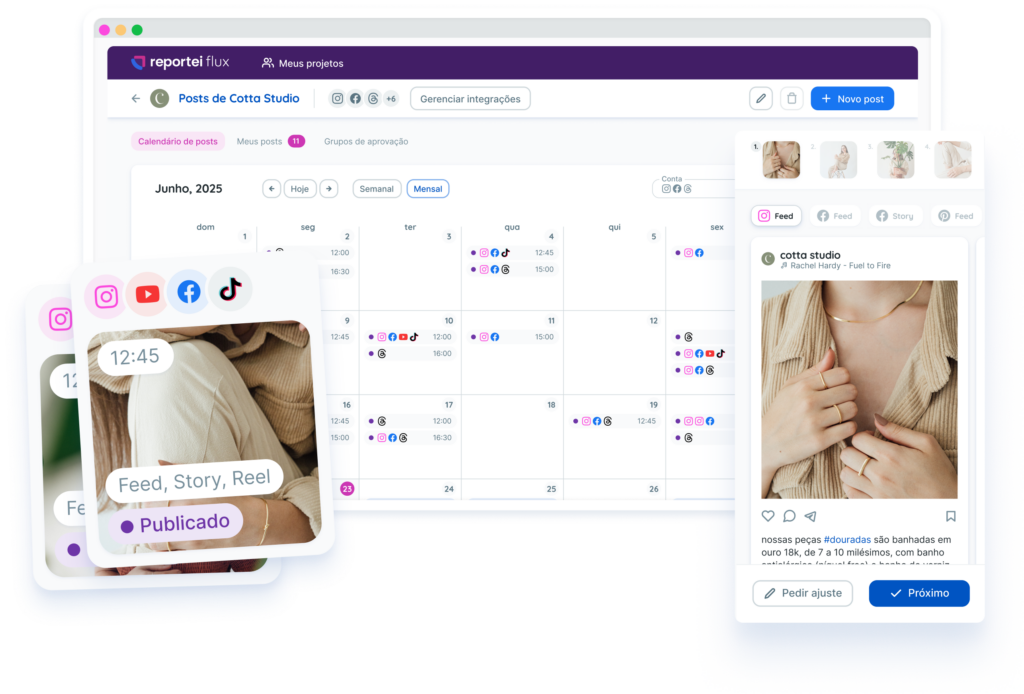
With it, you can:
- Centralize all your social networks: Instagram, Facebook, TikTok, Threads, YouTube, LinkedIn, Pinterest, and more are grouped in a single dashboard, so you don’t have to keep switching between channels;
- Schedule content 10× faster: the editor lets you upload creatives, add captions, choose multiple networks, and schedule everything in record time;
- Build a visual, intuitive calendar: just drag and drop posts, change times, and spot content gaps at a glance;
- Set up visual workflows: assign tasks, track statuses (“in production”, “awaiting approval”, or “scheduled”), and keep your team aligned;
- Approve in batches: send groups of posts to clients or managers, collect feedback, and release posts without miscommunication.
And by scheduling posts in Flux and generating your reports in Reportei, you can keep your entire social media management strategy in one place.
This makes the whole process more efficient, whether you’re an agency, a freelancer, or a company that produces content in-house.

So if you’re looking for a professional, user-friendly post scheduler focused on productivity, Flux is the answer.
Explore Reportei Flux and discover how to schedule posts easily, securely, and at scale!
FAQ: common questions about the trend
Below are the most common questions about the Dump. Some were already answered throughout the article, but we’ve gathered them here for easy reference.
Photo Dump literally means “dumping photos”, but it refers to a posting format widely used on Instagram.
A Photo Dump is an Instagram content trend that consists of sharing collections of seemingly random photos that, together, tell a story. It’s widely used by people and brands who want to show behind-the-scenes moments, memories, or genuine moments, creating a closer relationship with their audience.
To use a Photo Dump, just select 3 to 10 photos that capture recent moments, post them as a carousel in the feed or as a sequence in stories, and keep the caption simple, like an emoji, a short sentence, or even an engaging question. The idea is not to worry about perfection, but to convey authenticity and connection.
A January Dump is a Photo Dump dedicated to January, bringing together moments from the start of the year. It often includes New Year’s resolutions, vacations, the post-holiday routine, and moments that mark the turn of the year, making it a creative way to sum up the month.
A September Dump is a Dump dedicated to September. It can feature photos of the change of season, projects getting back on track, personal or corporate events, and other highlights of the period, working as a relaxed visual recap of the month.
An October Dump is the monthly version of the Photo Dump dedicated to October. It usually includes autumn vibes, Halloween celebrations, cozy get-togethers, seasonal outfits, and other memorable moments of the month, gathered in an authentic, relaxed carousel.
Final thoughts
All of this shows that the Photo Dump is more than a passing trend. It is a reflection of a shift in the behavior of social media users, who are looking for authenticity and real connections.
For businesses, this is an opportunity to get closer to their audience, humanize their brand, and stand out from the competition.
So don’t be afraid to open the doors of your business and share relaxed moments that show what really happens. After all, these are the stories that build connections and attract customers.
– Read also: Instagram Engagement: 14 Tips to Increase Your Brand’s Engagement Rate