
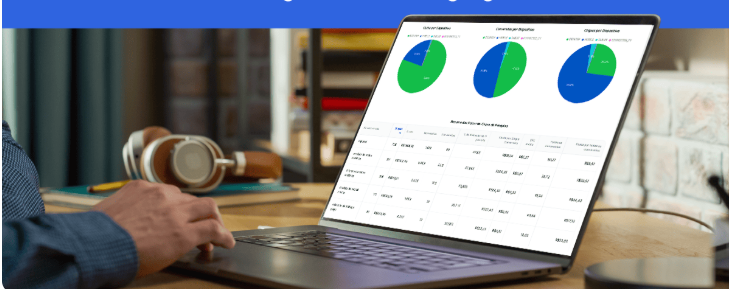
Check out 6 tips to make the most of your dashboard data and improve your digital marketing strategies
In the dynamic world of digital marketing making data-driven decisions is essential for a company’s success. It is in this context that digital marketing dashboards stand out as they offer a consolidated and appealing view of the key metrics for your business.
Therefore, in this article, we will explore how to use efficient dashboards to enhance digital marketing strategies, from the appropriate selection of metrics to data interpretation and action based on the insights obtained. Keep reading to check it out.
Understand the importance of dashboards in data analysis
But before we present tips for implementing an effective dashboard, we need to discuss its importance, as this tool plays a crucial role in the analysis of digital marketing data.
In addition to being an effective solution for the organization, monitoring and interpretation of data from various sources such as Google Analytics, social networks, email marketing, paid media and much more, the metrics dashboard provides a panoramic and more agile view of your campaign’s performance in real-time.
In other words, instead of spending hours navigating through different channels to collect and analyze scattered data, a good digital marketing dashboard model allows you to access all relevant information in a single, organized, and easily. understandable place.
Along with this, it allows you to identify trends, patterns, and correlations between different metrics With clear data visualization and intuitive charts, you can track the performance of your strategies over time and compare different periods to understand the evolution of your business.
From this, it becomes easier to gain valuable insights into the impact of specific actions and campaigns, allowing you to make more informed decisions about resource allocation, strategic adjustments, and optimization of results.
6 tips for successfully implementing a marketing dashboard
But far beyond having a dashboard model at hand, it is necessary to know how to extract information and insights to make it truly efficient. Therefore, to assist in this process, we have selected below 6 essential tips to use the metrics dashboard as a source for better decisions. Let’s go.
1 Define goals and objectives
Defining clear goals and objectives is extremely important for the effectiveness of a digital marketing dashboard. After all, it is through them that you create benchmarks to measure the success of your strategies and campaigns.
Indeed, the goals are the starting point for defining the metrics to be monitored on the dashboard, helping to focus on what is truly important for the success of your business and on opportunities that enhance actions across different channels.
However, for the goals to truly work, it is essential that they are achievable and measurable so that the team can use them to make better decisions.
2 Select the right metrics
Choosing the right metrics for your digital marketing dashboard is a fundamental step to ensure that you are tracking the most relevant information that will drive your strategies. In this way, we have selected some guidelines to help in this process.
- Align the metrics with the overall business objectives Ask yourself which information is essential to measure progress towards the desired results. For instance, if your goal is to increase online sales, ecommerce metrics such as conversion rate, average ticket, and cart abandonment rate are essential
- Choose actionable metrics that are within your control and can be influenced by your actions. After all, the purpose is to make them lead to strategic decision-making
- Consider your business context since what is considered good performance for a metric in one sector might not be the same for another
- Avoid vanity metrics that do not have a real impact on your results. For example, the total number of likes on a social media page may seem impressive but is not a direct indicator of success in terms of conversions or sales. Prioritize data that aligns with tangible results and provides actionable insights.
- Adjust over time to review and adapt the dashboard metrics as your strategies and objectives evolve
3 Understand the context
Understanding the context of each period analyzed in the digital marketing dashboard involves having a comprehensive view and clear understanding of the various factors that can influence the data and metrics presented on the panel.
After all, this process not only aids in the correct interpretation of the data but also in the identification of the causes and effects behind the captured data For example, if a conversion metric is below expectations, understanding the context can reveal whether there have been recent changes in actions, competition, target audience preferences, or seasonal factors.
Thus, it becomes easier to make more assertive decisions and truly improve digital marketing strategies.
4 Compare time periods
Another important point for achieving better results from the analysis of digital marketing dashboards is to compare different time periods, as it becomes simpler to identify trends, seasonal patterns, and changes in target audience behavior over time.
Moreover, this practice also helps to understand the impact of changes made in digital marketing strategies For example, if you performed an optimization on a Google Ads campaign comparing the before and after results can reveal the impact of this action and help make better future decisions.
5 Conduct tests and experiments
Conducting tests and experiments based on dashboard data is an essential practice in digital marketing since it allows obtaining valuable insights, testing hypotheses, and making informed decisions to optimize strategy performance.
After all, it becomes easier to determine which approaches can yield better results, reduce risks associated with changes or significant investments, and create a routine of learning and innovation for the project.
6 Automate the metrics collection process
Finally, we must mention the automation of metrics collection as a way to assist in the better use of digital marketing dashboards. After all, with it, the data is updated more quickly and completely, allowing you to have more time to focus on what really matters: analysis and decision making.
For this, you can rely on a report automation tool such as Reportei In addition to integrating with channels in a few minutes and generating dashboards in seconds, our platform enables panel customization, real-time analysis, and sharing with clients or teams so that everyone stays on the same page.
In other words, it is possible to focus on improving results and betting on digital marketing strategies that truly work for each project.
Did you enjoy our tips on how to work better with dashboards and their data? Then be sure to check out our two free certifications from the Reportei Academy to become a Data Driven Analyst!
With them, you leave the world of guesswork and learn practically how to analyze digital marketing metrics and present results to your clients. Access the courses via the following links: