Learn what a marketing funnel on social media is and how to create content for the top, middle, and bottom stages.
The marketing funnel on social media has become one of the most important concepts for brands looking to turn digital presence into tangible results.
After all, many companies frequently produce content, invest in videos, carousels, stories, and even paid campaigns, yet still face a common challenge: views grow, reach increases, but sales don’t keep up with this momentum.
In most cases, this happens because the content isn’t connected to a structured strategy.
Thus, when posts are published without a logic guiding the audience through the buying journey, social media ends up serving merely as an exposure channel rather than a real conversion channel.
In other words, by structuring content for the top, middle, and bottom of the funnel, it becomes possible to guide the audience within these channels, creating an experience that results in sales.
Therefore, in this article, we will show how the funnel works when applied to social media and how it can be adapted for platforms like Instagram and TikTok. Follow along.
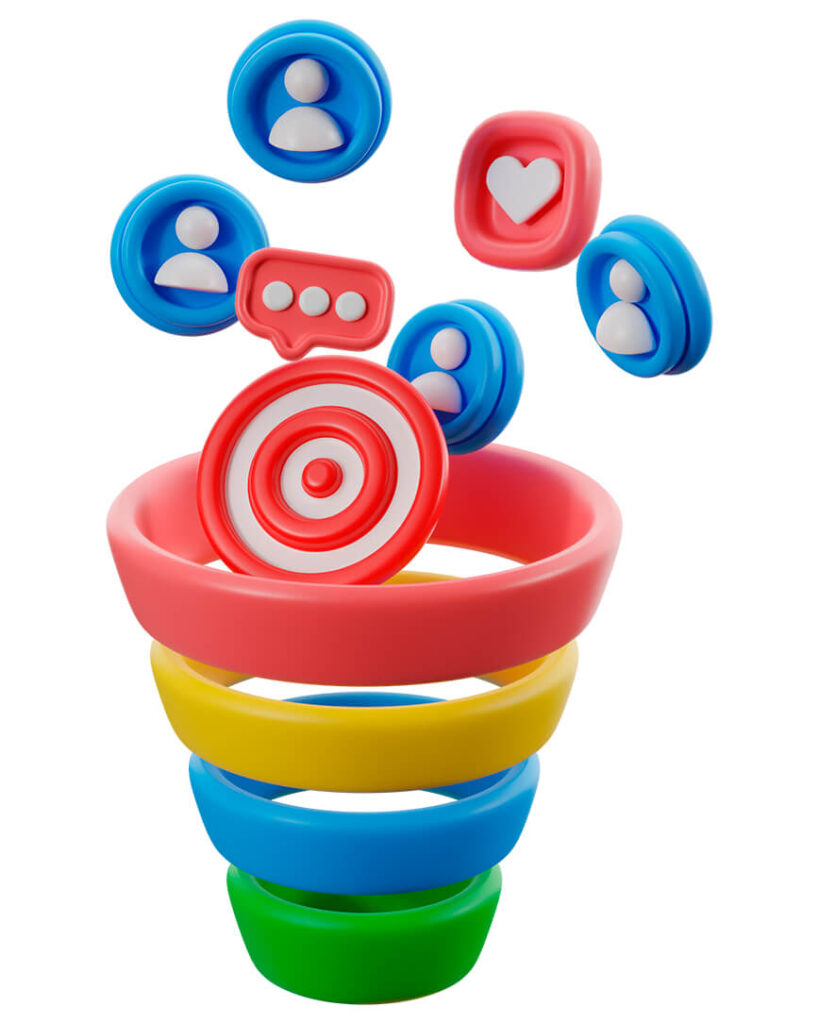
What is a marketing funnel on social media?
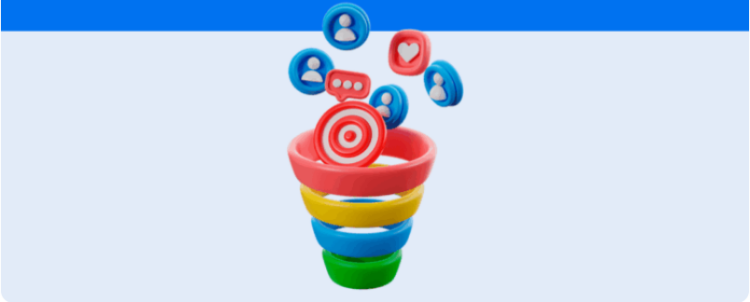
Simply put, the marketing funnel on social media represents the journey a user takes from their first contact with a brand to the purchase decision.
Thus, instead of focusing on individual posts, the strategy considers how each post contributes to moving the audience throughout this journey.
From this, content functions as a tool that guides the user from one stage to another.
For example, some posts are responsible for generating discovery, others help deepen the relationship, and some are created with a focus on conversion.
Thus, we can understand that not all content needs to sell directly.
So, when we apply this logic to social media, the funnel is typically divided into three main stages.
| Stage | Objective | Characteristics |
| Top | Discovery | Attract new audiences and broaden reach. |
| Middle | Relationship | Build authority and generate interest. |
| Bottom | Conversion | Encourage purchase decisions. |
Another interesting aspect is that social networks themselves help nurture this process.
When a person interacts with content by liking, saving, or commenting, the algorithm tends to show new content from the same profile.
As a result, the platform’s environment itself contributes to the user continuing to advance in the journey.
Next, check how the stages of the sales funnel work on social media in practical terms.
How the top of the funnel works on social media.
To begin, the top of the funnel represents the discovery phase.
In other words, it’s the moment when the brand gets in touch with people who don’t yet know the profile or product.
For this reason, the main objective at this stage is not to sell but to expand the account’s reach, generate visibility, and spark curiosity about the content.
Thus, top-of-the-funnel content tends to be more accessible and easy to consume.
Additionally, they address topics relevant to the audience and are often connected to common doubts or market trends.
Types of content for TikTok and Instagram.
Both on Instagram and on TikTok some formats work especially well at this stage mainly because they favor discovery and sharing.
Below are some of the most common examples.
| Educational Reels with quick tips that answer common audience questions. Informative carousels explaining concepts or presenting lists of ideas. Trend-based content adapted to the brand’s context. Posts with insights or curiosities that encourage sharing. | |
| TikTok | Short videos with simple, direct explanations. Content answering common audience questions. Trends adapted to the niche. Videos with short storytelling or personal experiences. |
It’s worth noting that this type of content increases the chances of discovery because it is easily distributed by the algorithm to people who don’t yet follow the profile.
Important metrics
Now, to assess whether the top of the funnel is functioning efficiently, it’s important to track some specific metrics. Among the main ones are:
- Reach
- Impressions
- Video views
- Shares
- Follower growth
Together, these indicators help understand whether the content truly enhances the brand’s visibility and attracts new people to the profile.
Middle of the funnel on social media: building relationships.
After the audience discovers the brand, the next step is to deepen the relationship. This is precisely the role of the middle of the funnel.
Here, the audience already recognizes the profile, starts consuming content more attentively, and begins to perceive value in the shared information.
In other words, this is the stage where the brand builds authority and starts positioning itself as a reference within the topic.
Types of content for TikTok and Instagram.
| More comprehensive educational carousels explaining strategies or processes. Content detailing market concepts. Behind-the-scenes of the work or product. – Stories with questions, polls, and interactions. Explanatory lives or conversations with experts. | |
| TikTok | Videos with more detailed explanations. Content series on the same topic. Responses to followers’ comments. Content comparing strategies or tools. |
From this, we can see that the objective is to demonstrate knowledge and build trust.
Thus, the more the audience perceives utility in the content, the greater the chances are that they will continue following the profile.
Relevant metrics
To analyze the performance of this funnel stage, some metrics of social media engagement are especially useful, such as:
- Saves
- Comments
- Viewing time
- Profile clicks
- Interactions in stories
In general, these indicators help understand whether the content arouses the real interest of the audience.
For example, when there are more interactions, saves, and consumption time, it signals that people are engaging with the content and deepening their relationship with the brand.
Bottom of the funnel: content that generates conversion.
Finally, the bottom of the funnel represents the stage where the content takes on a more direct focus on conversion.
At this moment, the audience already knows the brand, understands the value of the product or service, and is closer to making a decision.
Therefore, the content at this phase typically has a clearer direction towards action.
Types of content for TikTok and Instagram.
| Customer testimonials. Case studies showing results. Demonstrations of products or services. Stories with offers or calls to action. Lives presenting solutions. | |
| TikTok | Product demonstrations in use. Comparisons with other solutions. Responses to purchasing questions. – Social proof and customer results. |
That is, these contents are designed to help reduce objections and facilitate decision-making.
Relevant metrics
When the goal is to analyze the bottom of the funnel, some indicators become even more relevant as they are directly tied to actions indicating purchase intent.
Among them, we can highlight:
- Clicks on links
- Generated leads
- Conversions
- Revenue attributed to campaigns
Thus, unlike the previous funnel stages, the focus here is to track more concrete results for the business.
After all, these are the data that help understand whether the content and campaigns really encourage the audience to move to the next stage, whether by leaving a contact, accessing a page, or completing a purchase.
How to analyze the performance of the funnel on social media.
As we have seen throughout the article, for the funnel to truly work, it is not enough to just regularly produce content.
In addition, it is essential to track results in a structured way and understand how each publication contributes to the audience’s evolution within the journey.
This is because when we only analyze isolated posts, it is difficult to see the real impact of the strategy.
Thus, the ideal is to observe performance more broadly, considering the role of each content within the funnel.
In fact, some analysis practices help greatly, such as:
- Performing a segmented analysis by funnel stage to understand which types of posts generate discovery, which deepen relationships, and which contribute to generating conversions.
- Comparing campaigns and formats that brought better results and identifying patterns. Thus, you can replicate strategies that work and adjust content that did not perform as well.
- Tracking evolution over time through metrics such as reach, follower growth, engagement, and conversions. This allows understanding whether the funnel is evolving healthily or if there are bottlenecks at any stage.
Additionally, using an appropriate analysis tool like Reportei makes all the difference.
After all, our platform allows centralizing data from different social networks in a single dashboard, which makes it easier to visualize the performance of content and campaigns.
In other words, instead of relying on spreadsheets or isolated screenshots, you get organized reports that more clearly show the evolution of metrics at each stage of the funnel.
Therefore, if you want to monitor your social media strategy more organizedly and transform data into more strategic decisions, it’s worth trying out Reportei for free and view the performance of your marketing funnel in a much more structured way.
FAQ: Frequently asked questions about the subject.
When starting to structure a marketing funnel on social media, it’s natural for some doubts to arise about how to apply this logic in the day-to-day of content creation.
Thus, we’ve gathered some of the most common questions on the subject below.
It’s the framework that organizes content according to the user’s journey. The strategy divides content into top, middle, and bottom of the funnel, guiding the audience from brand discovery to purchase decision.
The main difference lies in the behavior of the platforms. TikTok has a strong focus on discovery, while Instagram tends to favor more relationship and conversion, mainly through educational carousels and stories.
In practice, yes. Even if not formally structured, any strategy involves stages of discovery, relationship, and conversion. Organizing this process helps to turn content into more consistent results.
There isn’t a fixed proportion, but many strategies concentrate a larger volume at the top of the funnel, followed by middle content, and a smaller amount of content focused directly on conversion.
Metrics analysis greatly helps in this process. Reach growth indicates advancement at the top, increased engagement shows middle evolution, and conversions indicate results at the bottom of the funnel.
Yes. Many brands use content series, interactive stories, educational carousels, and explanatory videos to deepen the relationship before directing the audience towards conversion.
Yes. Analysis tools allow tracking metrics from different social networks, comparing campaigns, and visualizing the evolution of funnel stages, facilitating strategic decisions.